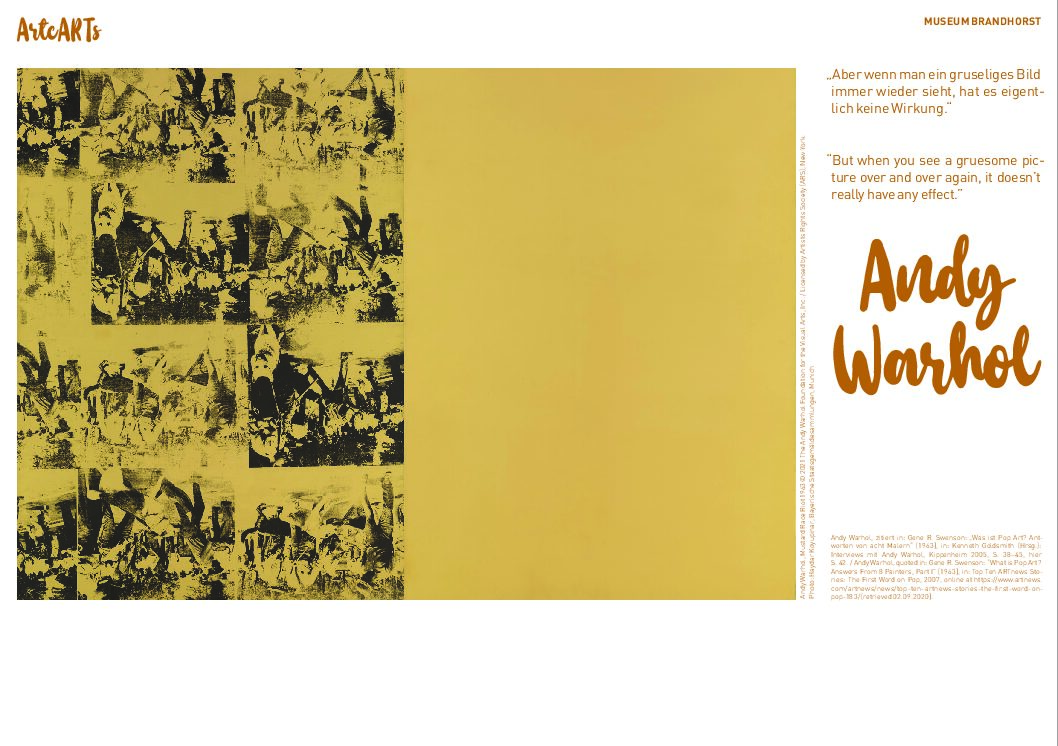
Mustard Race Riot, 1963
Information about the artwork
- Material2 parts; acrylic and silkscreen ink on canvas
- Dimensions289.3 x 416.6 cm
- Year of acquisition2004
- Inventory numberUAB 642
- On viewCurrently not exhibited
- Copyright© 2022 The Andy Warhol Foundation for the Visual Arts, Inc. / Licensed by Artists Rights Society (ARS), New York.
More about the artwork
Andy Warhol’s “Mustard Race Riot” is an outstanding example from his “Death and Disaster” series. With this series, Warhol documented drastic events that dominated the American news and media coverage at the time: electric chairs, fatal car accidents and plane crashes, but also reports of food poisoning. The photographs used for “Mustard Race Riot” show the violent assault by police officers—armed with sticks and dogs—on peacefully demonstrating Black civil rights activists in a park in Birmingham, Alabama. With this motif, Warhol once again succeeded in channeling the mood of the country. Not least because of the publication of Charles Moore’s photographs in “Life” magazine in May 1963, the assault suddenly became widely known. The civil rights movement could no longer be regarded as just a “problem” of the South, but had exposed itself as an issue that affected the entire country. Warhol’s choice of the word “riot”, a term associated with violence, to describe the protests, reflects the parlance of that time. It meant however that he, as a White artist, repeated a term that gave the peaceful civil rights movement a negative, even illegal image. In truth, the violence was and still is committed by the US state and its structure of institutional racism.
The fact that Warhol juxtaposes a densely printed panel with a monochrome one, emphasizes his interest in how the media operate: images are replaced at ever faster intervals, they fade, even disappear from our memories. The media’s banality and arbitrariness – which was often also inhuman – fascinated Warhol.